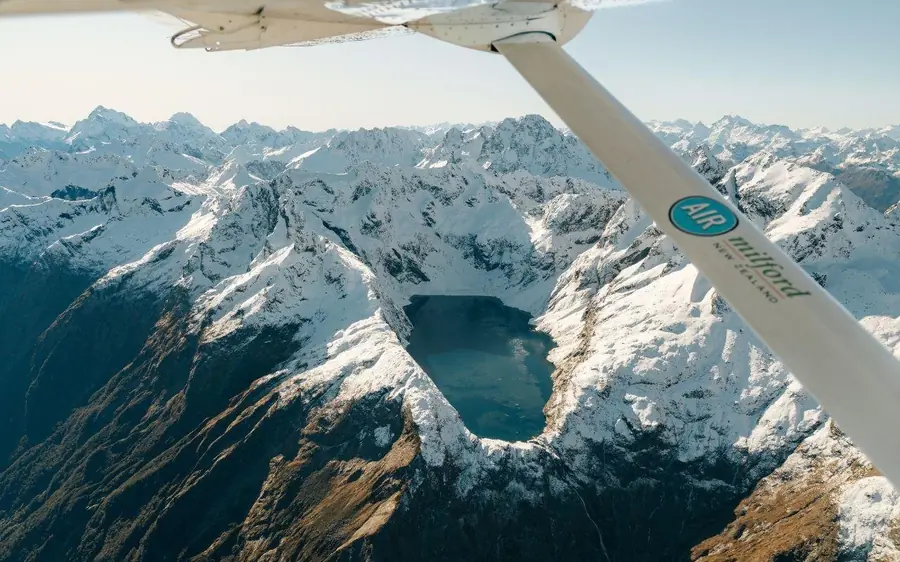
Rated 5.0Small boat
4h 30mFrom Queenstown: Milford Sound Flight and Nature Cruise
★ 5 · 278 reviews
- A small-boat nature cruise, not the big catamaran
- Family-run operator
- 278 reviews at 5.0
- Free cancellation
$486$108.00 / hour
Check availability→ The boat
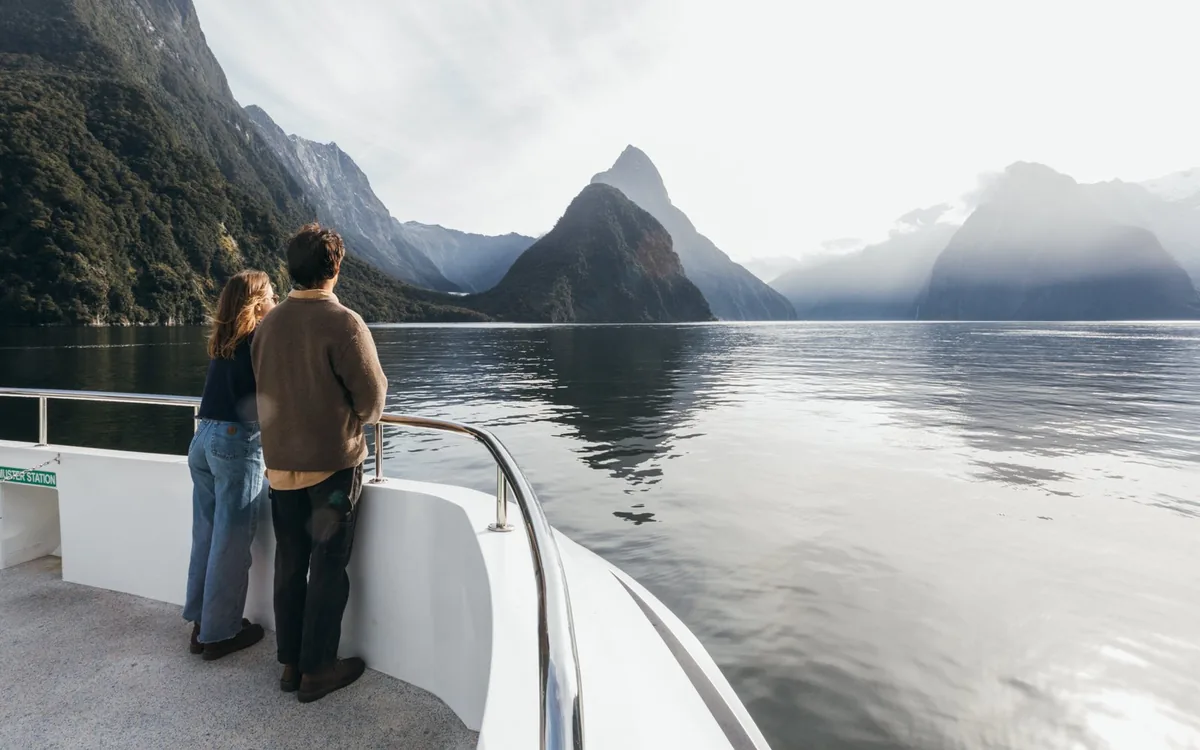
Every combination on this page includes about two hours on the water, and people compare the flights closely while ignoring the boat entirely. That is a mistake: the boat decides whether your two hours are spent on an open deck with forty people or a covered one with two hundred, and whether you get close enough to the Stirling Falls to feel the spray.
Quick answer
Two kinds of boat run the fiord: large catamarans carrying up to several hundred, and small boats carrying a few dozen. The large ones are steadier, have more indoor space and usually include food; the small ones get closer to the walls, spend longer at the falls and have far more deck per passenger. The small-boat combination on this page is $486, with 278 reviews at 5.0.
What a large boat does better
Warm, dry, steady and usually fed.
Indoor space. Two hours in a Fiordland southerly is a long time on an open deck. The large boats have proper saloons with big windows, and on a wet day that is worth a lot more than it sounds in a brochure.
Steadiness. A catamaran in the swell at the mouth of the fiord moves less than a small boat does. If anyone in the party is prone to seasickness, this matters.
Food. Most of the large-boat combinations include something; the small-boat ones usually do not.
Commentary. Professional and scheduled, over a public-address system, rather than the skipper talking to you.
What a small boat does better
Closer to the walls, and far fewer people.
It gets closer. A small boat can nose into places a catamaran cannot, and it spends longer doing it. Under the Stirling Falls this is the difference between a photograph and getting wet.
Deck per person. Forty people on a small boat have more room outside than three hundred on a large one, and the fiord is an outdoor experience whatever the weather is doing.
The skipper talks to you. Not at you. On the small-boat combination at $486 — a family-run operator with 278 reviews at 5.0 — the commentary is a conversation.
Quiet. Which in a fiord with walls a kilometre high is most of the point.
Book direct
The family-run small-boat cruise first, then the three that use the larger boats.
★ 5 · 278 reviews
★ 4.9 · 322 reviews
★ 4.9 · 1,831 reviews
★ 4.8 · 128 reviews
Six things about the cruise half of a Milford Sound flight and cruise
The flight gets all the attention; the boat is where you spend most of the time.
A fiord a kilometre deep with walls a kilometre high does not warm up. Bring a layer even in January.
And it is the first place to fill. Go straight there when you board.
Stirling and most of the temporary falls are on the northern wall. Going out you want the starboard side.
Within an hour of heavy rain the walls run with hundreds of temporary waterfalls.
Long enough to reach the Tasman Sea and come back without loitering.
Near the mouth, on the southern side. Look for shapes that do not match the rock.
Common questions
A small boat for closeness and quiet; a large catamaran for warmth, steadiness and food.
$486 — a family-run operator with 278 reviews at 5.0.
About two hours on every listing here, which is enough to reach the Tasman Sea and return.
Most nose in close to the Stirling Falls, and the spray reaches the deck.
More often on the large boats than the small ones. It is stated on each listing.
The fiord is sheltered for most of its length; the swell at the mouth is where people notice it. A catamaran moves less than a small boat.
It is the longest part of it. About forty minutes in the air each way against about two hours on the water, on every listing here.
Why the boat matters more than people think
Two hours of a four-and-a-half-hour day.
Add it up: about forty minutes in the air each way, and about two hours on the water. The cruise is the largest single piece of the day on every Milford Sound flight and cruise on this page, and it is the part people research least.
What the boat decides. How much deck you have, how close you get to the walls, whether there is anywhere warm to stand, and whether you are fed.
What it does not decide. The route. Every boat runs the same fifteen kilometres to the Tasman Sea and back, past the same two permanent waterfalls.
So the question is not which boat sees more — they all see the same thing — but how you would rather spend two hours looking at it.
Five questions to ask about the boat
All of them answerable from the listing.
A few dozen or a few hundred, and the difference is most of the experience.
You will want it in any weather. Deck per passenger is the number that matters.
Most do on a two-hour cruise; the shortest ones turn earlier.
More often on the large boats. On a Milford Sound flight and cruise of four and a half hours it matters less than on a nine-hour one.
Most do, and the spray reaches the deck. It is the moment people photograph.
In short
Same route, very different two hours.
About forty minutes in the air each way, and about two hours on the water. On every Milford Sound flight and cruise here the boat is the longest single piece of the day.
Small boat — $486, 278 reviews at 5.0. Closer to the walls, more deck each, and the skipper talks to you.
Large catamaran — our top pick and most of the rest. Warmer, steadier, usually fed, and far more indoor space for a wet Fiordland afternoon.
Every boat runs the same fifteen kilometres. What changes is how you spend them.
What to do in your two hours on the water
The cruise half is where most of the day goes; these are the things people wish they had done.
The bow fills within a minute of boarding and does not empty until the return leg.
Side valleys that end in mid-air a few hundred metres above the water, with waterfalls coming out of them. They are easier to spot from the boat than from the air.
A layer of fresh water several metres thick sits on top of the salt without mixing, stained by tannin from the rainforest. It is why the fiord photographs almost black.
The boat noses in bow-first and backs out; the best view of the whole fall is on the way out.
Another boat, or a person on the rail. Without it, a kilometre of wall reads as a hundred metres.
The light at the head of the fiord late in the afternoon is the best of the day, and by then almost everyone has gone inside.
Go deeper
From $431 for the whole day, and what the helicopter adds.
The verdictTwelve combinations, and the four worth your money.
Road or airTwelve hours of coach against four and a half in the air.
Heli or planeWhat each one can do that the other cannot.
LandingsBeach, snow and alpine ridge — the stops no road reaches.
BookingWeights, weather rules and what sells out.
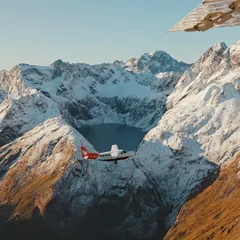
Queenstown: Milford Sound Flight and Cruise
★ 4.9 · 322 reviews · Free cancellation 24 h